From zero to a full calendar: a counsellor's site build, SEO, CRO and rebuild
From under 1% conversion and 2-3 enquiries a month to a full calendar and a 2-month waiting list. Years later, the entire site was rebuilt as a fast static replacement with no rankings lost in the migration.
The brief
The client was a counselling and therapy practitioner specialising in gestalt therapy, offering both online and in-person consultations. She'd come highly qualified and had a solid range of services on offer, but was generating basically no consultations through her website. The existing site at the time was a static one-page placeholder with basic service info and effectively zero visibility in search.
Phase 1 - The site build
I proposed and executed a full digital rebuild, designing a new WordPress site from scratch around therapy-practice SEO and conversion optimisation.
To start with, the architecture was basically a homepage with value propositions and an immediate booking CTA, an about page covering credentials and therapeutic approach, seven optimised service pages each targeting a high-intent commercial keyword, a Learning & Resources blog as the educational content hub, a streamlined contact and booking flow with an integrated form plugin, and GDPR-compliant privacy and policy pages that doubled as trust signals.
Each service page included detailed service descriptions with clear benefits, the client's specific approach and methodology, FAQ sections addressing common concerns, and trust signals for E-E-A-T (qualifications, experience, testimonials), with multiple conversion opportunities placed throughout each page.
On the technical side, the build included responsive mobile-first layout, page-speed optimisation across the board, local schema markup and structured data, SSL certification, and GDPR-compliant contact-form integration with automatic follow-ups.
I then developed three strategic content clusters for the Learning & Resources section, supporting the service pages while capturing users at different stages of the therapeutic journey. For each cluster I mapped specific keywords to potential blog posts so that each piece served distinct search intent while reinforcing the authority of related service pages.
To make sure the blog content would rank consistently, I provided detailed blog outlines and a content calendar incorporating semantic keyword integration, user intent optimisation, content depth requirements, internal linking opportunities, E-A-T enhancement and featured-snippet optimisation.
These outlines enabled the client to produce content that consistently ranked, and that content continues to drive approximately 80% of qualified traffic to the site.
Phase 2 - Strong search, weak conversion
Months 1 to 3 saw four of the seven service pages ranking on page one for target keywords, alongside a significant improvement in local search where the client reached position 5 for her main location-based keyword. Blog posts started ranking and growing month-on-month across the whole site.
At this stage the traffic was good, although the conversion rate from visitors to consultation bookings was sitting under 1%. People were engaging with the content but stopping after that without taking action. Service and blog pages were generating plenty of awareness, with the conversion side of the funnel underperforming.
Diagnosing the issue revealed that potential clients were hesitant to commit straight to a full therapy session, and uncertain whether their needs matched the client's approach (aka the commitment threshold was too high).
I implemented a "Free 10-Minute Discovery Call" strategy as the primary CTA across every blog and service page. Shifting the offer from "Get in touch" to "Free Discovery Call" repositioned the conversation as risk-free for the prospect, which made a substantial difference to conversion almost immediately.
Phase 2 results
By months 3 to 6:
- 1,500 total site clicks over the quarter (around 500 per month average)
- Top blog post bringing around 500 clicks (a third of total traffic)
- Steady growth across all seven optimised service pages
- Position 2 in Google Maps for "gestalt therapy london"
- Conversion rate jumped from under 1% to 3-4%
- 15-20 discovery calls booked per month, up from 2-3 enquiries
- Full calendar with a two-month waiting list established
Phase 3 - The 2026 rebuild
Three years after the original launch, the client got back in touch as they wanted a redesign and more SEO work. The WordPress site was still performing well, with a full calendar and healthy rankings, but it was looking outdated.
The brief for the rebuild was specific: refresh the site without breaking anything that was working.
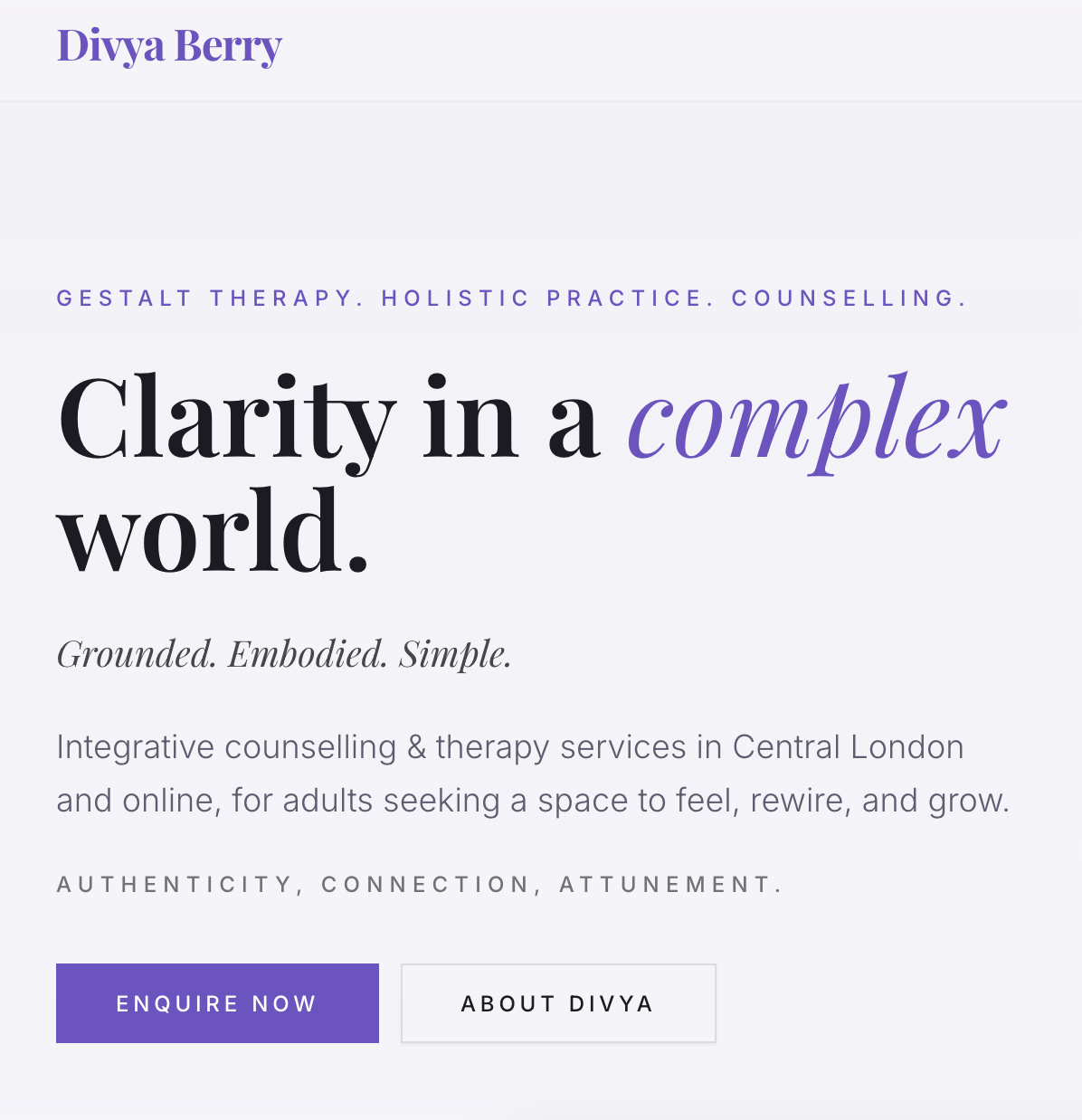
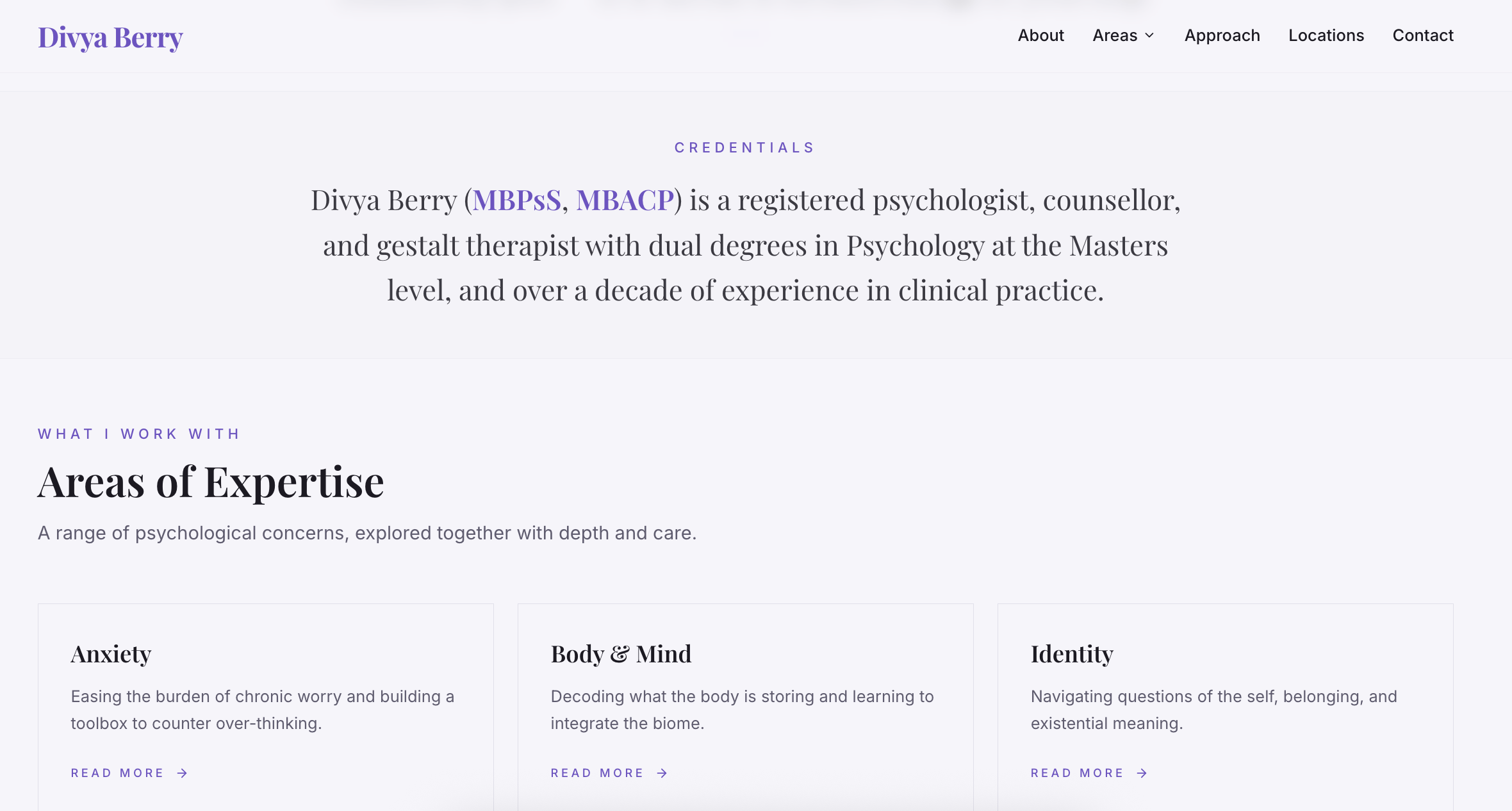
I rebuilt it as a fast static site, hand-coded, with no CMS overhead and a dramatically lighter frontend. The architecture stayed identical and all the URLs were preserved (along with new URLs for new service and location pages), and the content structure was carried across in a subfolder. Visually the site was completely refreshed and modernised (check it out!)
The tricky part was the actual migration, since every URL needed preserving, every redirect mapped, and every piece of internal linking carried across cleanly to the new build. After the migration was done:
- Zero rankings lost across the seven service pages
- Local map result held its position
- Core Web Vitals improved substantially across LCP and TBT
- New rankings gained for new service and location pages
- Primary AI Overview citations gained for key terms
Reflections
I can see four things worth pointing out from this multi-year project.
The first lesson is that architecture definitely has to come before optimisation. The original rebuild proposal on WordPress drew some resistance from the client, who liked the look of her static one-pager and didn't see why we needed to touch the foundations. Rebuilding in WordPress with the structural foundation for SEO and conversion was basically the precondition for everything that came after it; the static site was not going to perform on search.
The second lesson came out of Phase 2, where the same content base went from 2-3 monthly enquiries to 15-20 through one CTA reframing. CRO can multiply SEO returns even better than extra traffic, which is a counterintuitive but important point.
The third lesson belongs to the local-business category specifically. In service-based businesses with a geographic anchor, top-three Map placements for the main service keyword can produce sustainable and high-intent visibility that national keyword rankings don't really tend to match (where enquiries are broader).
Fourth and finally, this project ran across four years and three distinct phases of work. That kind of long arc isn't typical with SEO, where the consultant-client relationship often ends after a few months of strategy delivery. Carrying through into rebuilds and updates years later turned the project into something more like an ongoing custodianship, and one in which I'm truly invested in and continue to work on with this particular client.