Parador.ai
Entity-level fact-checking for travel content. Catches the inaccuracies that erode editorial trust before they ship.
The problem
I travel a fair amount, and like most people who travel, I often check out travel content to find restaurants, bars, walking routes and places worth the detour. Over the years I've noticed how much that content tends to be out of date. Even big publishers like Time Out and Lonely Planet have tons of content on their site which mentions restaurants, bars and hotels that are completely out of date.
There's a structural reason for this, and it's because hospitality businesses in general have an extraordinarily high turnover / churn rate, with restaurants, bars and small hotels closing or changing hands all the time.
Travel articles can't keep up with this, and the bigger the publication, the more visible the problem, because at scale even a small percentage of stale articles adds up to a lot of misled readers.
So I built a tool that solves for it. Parador AI is pretty simple: it extracts the named entities from a piece of travel content (restaurants, hotels, addresses, opening hours, attractions) and cross-references each one against authoritative APIs. Where it finds discrepancies between what the article says and what the live data shows, it flags them with a confidence score and a suggested fix.
The original motivation was reader trust and editorial accuracy, although the tool turned out to have a useful side effect. Accurate entities and validated structured data are part of what AI answer engines use to understand a piece of content and decide whether to cite from it. So while Parador's primary value is on the editorial side, the AI and SEO visibility benefits are also pretty clear.
What it does
You paste in or upload the piece of travel content you want checking. Parador extracts every named entity from it, covering restaurants, bars, hotels, addresses, postcodes, opening hours, attractions and the other facts where accuracy matters most.
Each entity gets verified against authoritative public APIs that hold live information on the businesses and places named in the article. Google Places provides the data on addresses and opening hours, Wikidata handles attractions and historical entities, transport APIs check validity of timetables, and so on and so forth.
Parador returns a report listing every entity in the article alongside its live status, with discrepancies flagged and ranked by severity. A restaurant that is definitely closed will be flagged above one that might be closed or might have changed address. Each flag comes with the source it was checked against and a suggested fix for the article.

Inside the report
Each flagged discrepancy comes with a confidence score reflecting how certain Parador AI is that the article is wrong.
Every flag includes the authoritative source it was checked against, so editorial teams can verify the verification. The original API response is available behind each flag, with timestamps showing when the data was pulled.
Beyond the article content itself, Parador checks any schema.org markup the page is using for accuracy. Wrong addresses in LocalBusiness schema or stale opening hours in OpeningHoursSpecification get flagged in a separate 'technical SEO' scan, which protects rich result eligibility.
For publications with large archives of travel content, the tool can run in batch mode over a CSV of URLs. The output is a list prioritised by which articles need attention first, ranked by how much damage the inaccuracies are likely doing.
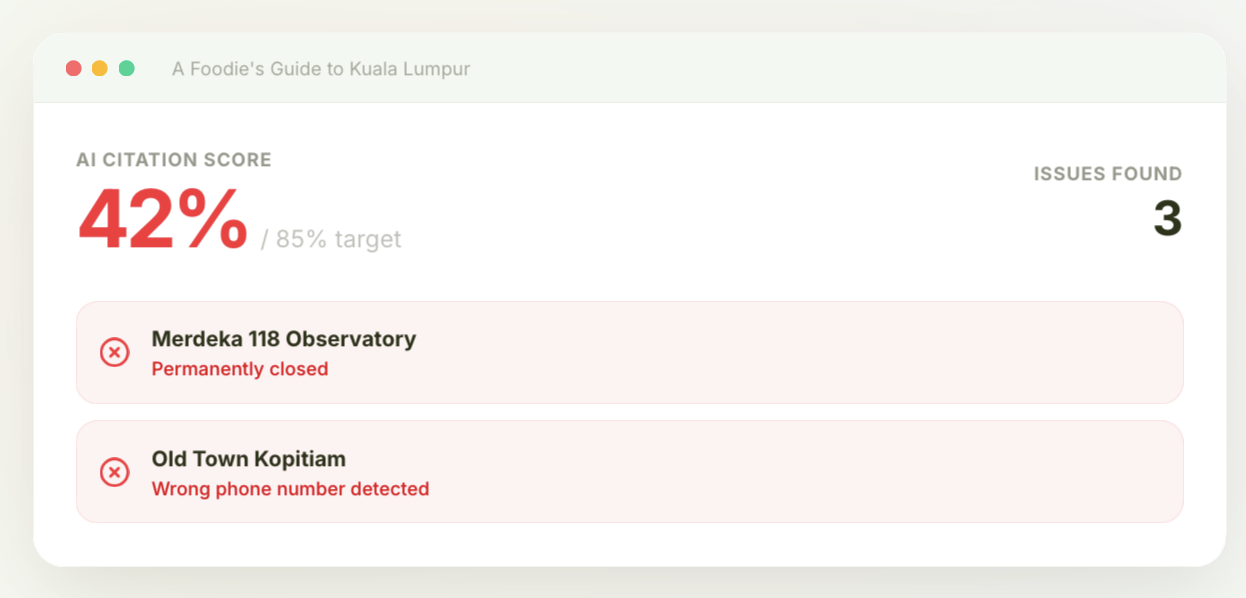
A scan of 'A Foodie's Guide to Kuala Lumpur' returns a 42% citation score with three issues flagged, including a permanently closed observatory and a venue with incorrect contact data.
A few honest caveats
This is a side project I built to scratch a personal itch with stale travel content, although it's turned into something more substantial since. At its heart it's a fairly simple thing: it just pull entities, checks them against live data and flags the differences, although incredibly no solution exists like this. There's plenty of room to improve but the basic idea is there.
For now, the link between entity accuracy and AI answer-engine visibility is intuitive but not fully documented, whereas it is clear that schema validity, for example, has a clear effect on rich result eligibility, and that's well-evidenced. The broader claim that AI engines reward accurate entities is harder to demonstrate with hard data, although it's a reasonable hypothesis based on how these systems work. The reader trust side of Parador is where the immediate, defensible value lives, although I'd like to position this tool from the AI visibility side as a useful companion for travel publishers.
Want early access?
Request accessI built this because I got tired of being sent to closed restaurants.
Parador started as an internal verification tool for travel client audits. It's now available in early access for publishers who want to verify their entity data before it ships.