Clustering keyword strategy for an eLearning platform
2.7K to 7K monthly clicks (+162%) and an 89% increase in course enrolment enquiries through cluster-based content silos.
The brief
The client was an eLearning platform offering responsive design courses for web and UX designers. Their traffic was heavily concentrated on course pages and brand-match queries, which had got them far enough but was limiting the business. They were missing the earlier stages of the learning journey, where informational queries signal interest / awareness in topics that could overlap with their course content.
The approach
I surfaced an initial list of 24 high-impact queries to base content around, organised into three content silos covering web UX fundamentals, CSS responsive design and accessible web design. Most of the queries were technical (aka users searching for explanations of specific responsive design methodologies), which was the kind of intent we could meet with educational content that positioned advanced courses as the natural next step.
Each silo was mapped to a distinct user persona who might be interested in specific course offerings on the platform. I outlined authoritative, detail-rich SEO content for every article, with pillar pages anchoring each silo, then we mapped logical pathways from the educational content to the relevant course offerings.
The deindexing challenge
In month 6, the highest-performing article was suddenly deindexed from Google. The piece had been driving around 1,200 monthly clicks, representing nearly 20% of total organic traffic on the site at the time. It was also a big conversion driver, so this was a pretty serious issue.
I ran a technical investigation through Screaming Frog and GSC to surface crawl and indexing errors. Analysing the deindexed page and its neighbours revealed three pages with partially overlapping search intent: the deindexed piece, an internally competing piece, and a third post that overlapped broadly with both of the other two. Google couldn't determine which page should rank for the main query (and related queries), so it algorithmically deindexed the strongest performer.
For the deindexed piece, I refocused the content exclusively on its core methodology, only referencing the competing topic through deliberate internal linking that established the relationship between the two. The internally competing piece got the same treatment in reverse, focusing tightly on its own angle. The third piece, which wasn't bringing significant traffic from its target keyword anyway, was 301 redirected to the deindexed (top-performer) piece.
Beyond that, I updated internal linking across a series of other blog posts to point to the most relevant page for each query, modified meta descriptions and title tags to distinguish search intent clearly, adjusted URL structure for better semantic clarity and updated the sitemap with proper priority signals. After resubmitting all three pages through GSC, the original article was restored to the index and regained its previous ranking position within two weeks. From there it went on to more than double the clicks it had been getting before the deindex.
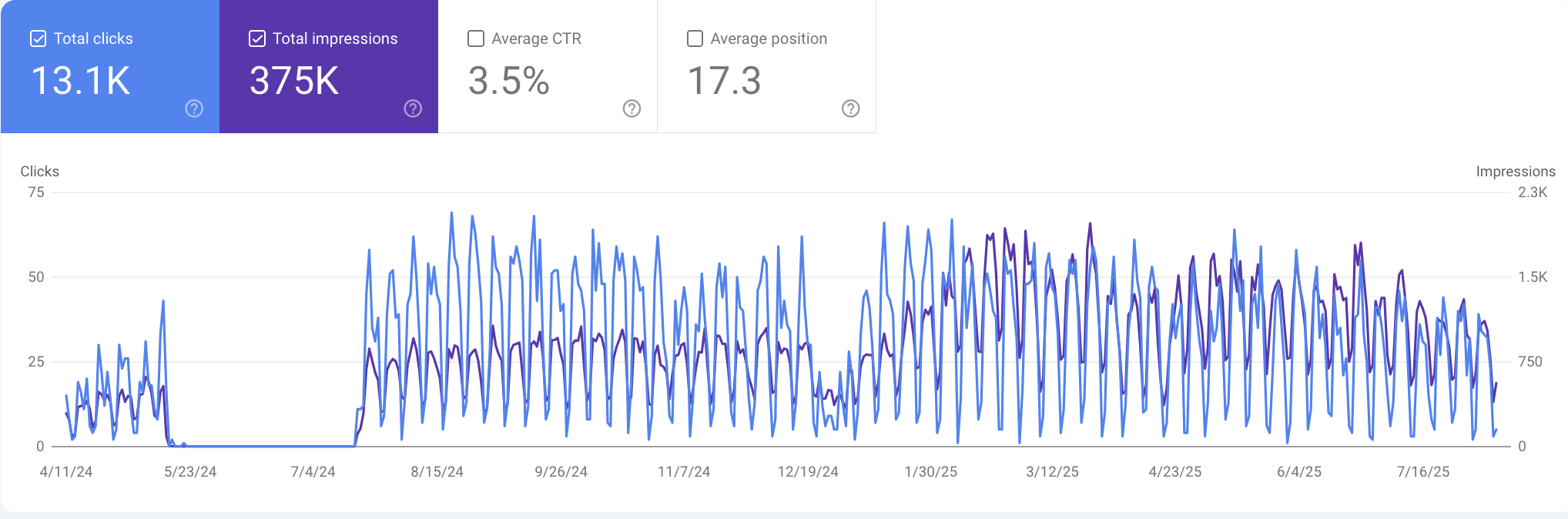
GSC data showing the traffic dip from the deindexing event and the recovery trajectory after the content differentiation fix.
The result
The campaign ran from April 2024 to July 2025. Over that period:
- Monthly clicks grew from 2.7K to 7.08K (+162%)
- Monthly impressions grew from 111K to 791K (+613%)
- Branded-search dependency fell from 78% to 34% of total traffic
- Course page traffic grew 45% in organic
Reflections
Two principles from this project stood out.
The first is that mapping content clusters to specific user personas does more for business outcomes than mapping to keyword volume alone. Traffic growth and business relevance compound when the audience and the content are properly matched, which is why the click increase translated so cleanly into qualified enquiries.
The second is that proactive content auditing is still relevant! The systematic recovery from the deindex produced stronger performance than the original article was getting, which is the upside. The downside is that the whole thing could have probably been avoided with a content audit before the issue arose. That audit would have caught the overlapping intent before Google did and we could have differentiated the pages well in advance.